Johnston, Richard. "White-Collar Crime Laws Need Toughening in Response to New Technologies." USA Today 130 (Jan. 2002): 36-38. Rpt. in White-Collar Crime. Ed. Kelly Wand. Detroit: Greenhaven Press, 2009. Opposing Viewpoints. Gale Opposing Viewpoints In Context. Web. 5 Jan. 2011.
White-Collar Crime
Wednesday, January 5, 2011
Trying to Fight This
Johnston, Richard. "White-Collar Crime Laws Need Toughening in Response to New Technologies." USA Today 130 (Jan. 2002): 36-38. Rpt. in White-Collar Crime. Ed. Kelly Wand. Detroit: Greenhaven Press, 2009. Opposing Viewpoints. Gale Opposing Viewpoints In Context. Web. 5 Jan. 2011.
Trying to Fight The Crime
On the Federal level, numerous regulatory and law enforcement agencies are authorized to combat specific economic crimes, including the Federal Bureau of Investigation, Secret Service, Postal Inspection Service, Securities and Exchange Commission, and Customs. Local law enforcement capabilities for combating economic crime vary, depending on the size and location of the department and the allocation of resources. Some larger municipalities and state law enforcement agencies have formed economic and computer crime units.
There are multiple programs and agencies that try to stop, prevent, or detect federal crime. Some include Coalition for the Prevention of Economic Crime, National Cybercrime Training Partnership, Internet Fraud Complaint Center, and National White Collar Crime Center. But are these enough to help protect the people against this crime.
Johnston, Richard. "White-Collar Crime Laws Need Toughening in Response to New Technologies." USA Today 130 (Jan. 2002): 36-38. Rpt. in White-Collar Crime. Ed. Kelly Wand. Detroit: Greenhaven Press, 2009. Opposing Viewpoints. Gale Opposing Viewpoints In Context. Web. 5 Jan. 2011.
Technology and White-Collar Crime Go Hand In Hand
Johnston, Richard. "White-Collar Crime Laws Need Toughening in Response to New Technologies." USA Today 130 (Jan. 2002): 36-38. Rpt. in White-Collar Crime. Ed. Kelly Wand. Detroit: Greenhaven Press, 2009. Opposing Viewpoints. Gale Opposing Viewpoints In Context. Web. 5 Jan. 2011.
Repaying Debts?
Todd, Ross. "White-Collar Criminals Rarely Repay Their Debts." American Lawyer 29 (Nov. 2007): S68-S72. Rpt. in White-Collar Crime. Ed. Kelly Wand. Detroit: Greenhaven Press, 2009. Opposing Viewpoints. Gale Opposing Viewpoints In Context. Web. 5 Jan. 2011.
Tuesday, December 7, 2010
Schools not teaching Ethics?
Good character can be defined as a composite of qualities, typically of moral excellence and firmness blended with resolution, self-discipline, high principles, and sound judgment. Our character establishes both our day-to-day demeanor and our destiny. Can these virtues be instilled through education? If so, can they build character?
Popular newspaper columnist Leonard Pitts writes that "reputation is about who you are when people are watching; character is about who you are when there is nobody in the room but you. Both matter, but of the two, character is far and away the most important. The former can induce others to think well of you, but only the latter allows you to think well of yourself." The ImClone scandal involving Martha Stewart is an example of how reputation and character are interrelated. Martha Stewart built an empire atop beautiful living. Yet, her involvement with ImClone and her conviction for making false statements to federal agents cast suspicion on her character and tainted her reputation. The evidence of her unethical behavior and dubious character dragged down the reputation of her business.
Overall can these crimes be the result of the educational system not preparing their students for the real world. It is very possible that schools and even more so colleges could have a role in white collar crime. It could be one long chain reaction that needs to be stopped somewhere. If the school has anything to do with it will these actions tend to continue or will they begin to disappear? Also if this is the case what can school do to help make sure they allow there student to build character and other quality traits that will make white collar crime begin to decline?
"White-Collar Crime Is the Result of Business Schools Not Teaching Ethics." White-Collar Crime. Ed. Kelly Wand. Detroit: Greenhaven Press, 2009. Opposing Viewpoints. Gale Opposing Viewpoints In Context. Web. 7 Dec. 2010.
Tuesday, November 9, 2010
Do White-Collar Criminals Do Less Time?
Because of spotty enforcement, white-collar criminals are far more likely to get away with their crimes than poor folks. And when they are caught, wealthy corporate executives can take refuge in their
Feige, David. "White-Collar Criminals Rarely Do Hard Prison Time." The Nation (23 June 2005). Rpt. in White-Collar Crime. Ed. Kelly Wand. Detroit: Greenhaven Press, 2009. Opposing Viewpoints. Gale Opposing Viewpoints In Context. Web. 9 Nov. 2010.
Monday, November 8, 2010
Breakdown
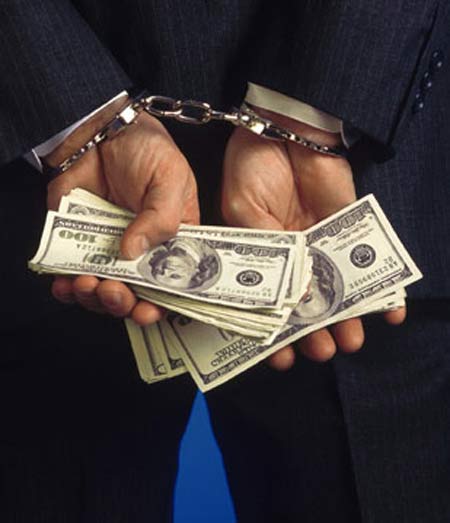
Through the history of time there has always been crime and corruption committed by office workers, executives, professionals, and politicians in connection with their jobs. First off the term white-collar refers to a person that usually wears dress clothing to work, like a suit and dress shirt.
People commit white-collar crimes to obtain—or to avoid the loss of—money, property, services, and personal or business advantage.
White-collar crime encompasses a variety of illegal activities—including bribery, forgery, investment schemes, and con games—designed to take the money of unsuspecting individuals. Many white-collar crimes involve fraud relating to credit cards, telemarketing, income taxes, banking, computers, or insurance policies. Embezzlement is the theft of money or property by a person who has been entrusted with it. Money laundering is the transfer or investment of money from illegal business dealings to conceal its source. Counterfeiting involves copying or imitating money and passing the copy to others as genuine.
"White-Collar Crime." Current Issues: Macmillian Social Science Library. Detroit: Gale, 2010. Gale Opposing Viewpoints In Context. Web. 8 Nov. 2010.